The problem with WordPress at scale
For many high-traffic websites, WordPress starts as a simple and flexible platform that grows together with the business. Over time, content libraries reach hundreds of thousands or even millions of articles, publishing becomes continuous, and traffic patterns become increasingly unpredictable due to SEO crawlers, aggregators, and bot activity.
At this stage, the main challenge is no longer feature development, but operational cost and architectural limits. A classic WordPress setup executes the full PHP core, theme logic, and plugin stack on every request. As traffic grows, this leads to higher CPU usage, heavier database load, and a constant need to scale infrastructure.
Website owners and CTOs often find themselves stuck between two expensive options:
- Continuously scaling server infrastructure to keep WordPress responsive under load, accepting rising hosting and maintenance costs
- Rewriting or heavily re-architecting the platform, which means high upfront cost, long delivery time, and significant risk
Neither option is attractive. Scaling infrastructure treats the symptoms but not the root cause, while a full rewrite often disrupts proven workflows and requires rebuilding years of accumulated functionality.
This is a common problem for WordPress-driven platforms that have outgrown the assumptions of a runtime-driven CMS but are not in a position to throw everything away and start from scratch.
Why typical “headless WordPress” doesn’t solve the real problem
When many companies talk about “headless WordPress,” they usually mean splitting a website into two separate parts: a frontend and a backend.
In simple terms:
- The backend is where content is created and stored. In most cases, this is still WordPress.
- The frontend is what visitors see in the browser. This is often rebuilt using modern frameworks like Next.js or Astro.
On paper, this sounds like a modern and scalable setup. In reality, for many content-heavy websites, it introduces new complexity without fixing the core issue.
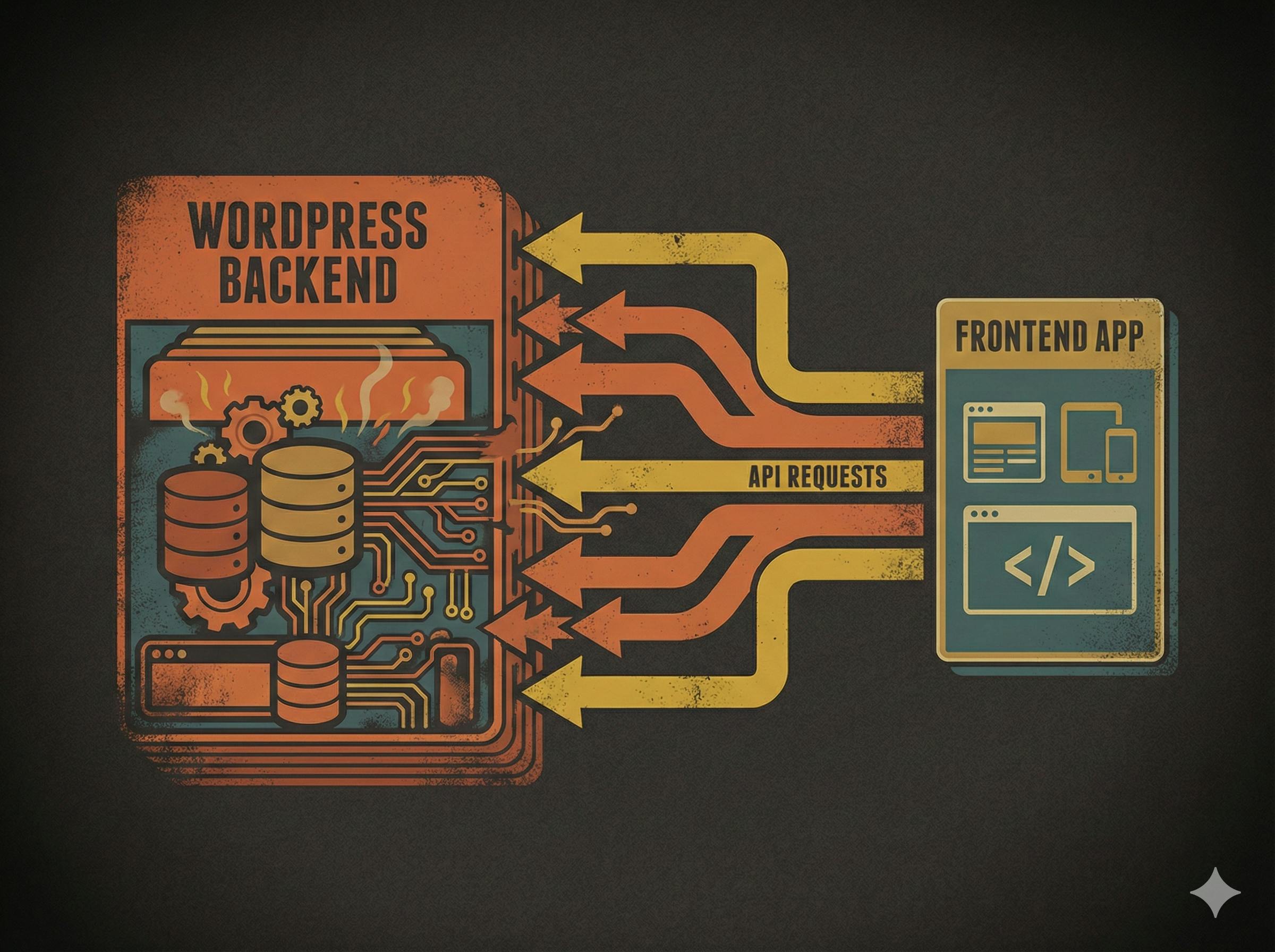
In these setups, WordPress remains fully responsible for generating content and responding to requests via APIs. The frontend becomes a separate application that constantly asks WordPress for data. While the frontend may feel “modern,” the backend is still running the same WordPress core, plugins, and database logic under load. The original performance bottleneck is still there.
From a business perspective, this creates several problems:
- The backend is still slow and expensive to run, because WordPress continues to handle most of the work
- The frontend only appears faster, often showing loading states while waiting for WordPress responses
- The system becomes harder to manage, especially for small or micro development teams
- Operational costs increase, because two separate applications now need to be maintained, deployed, and monitored
What’s often sold as a performance upgrade ends up being an architectural detour. The website becomes more complex, more fragile, and more expensive, while the original WordPress limitations remain unchanged.
For many site owners, this raises a valid question: if WordPress is still the bottleneck, and the frontend rewrite adds cost and complexity, is this really progress?
Our approach: using B2Storefront Connector to remove WordPress from the critical path
Instead of splitting WordPress into a heavy backend and an overengineered frontend, we took a different approach. The goal was not to replace WordPress, but to change when and how WordPress is used.
At the center of this model is the B2Storefront Connector.
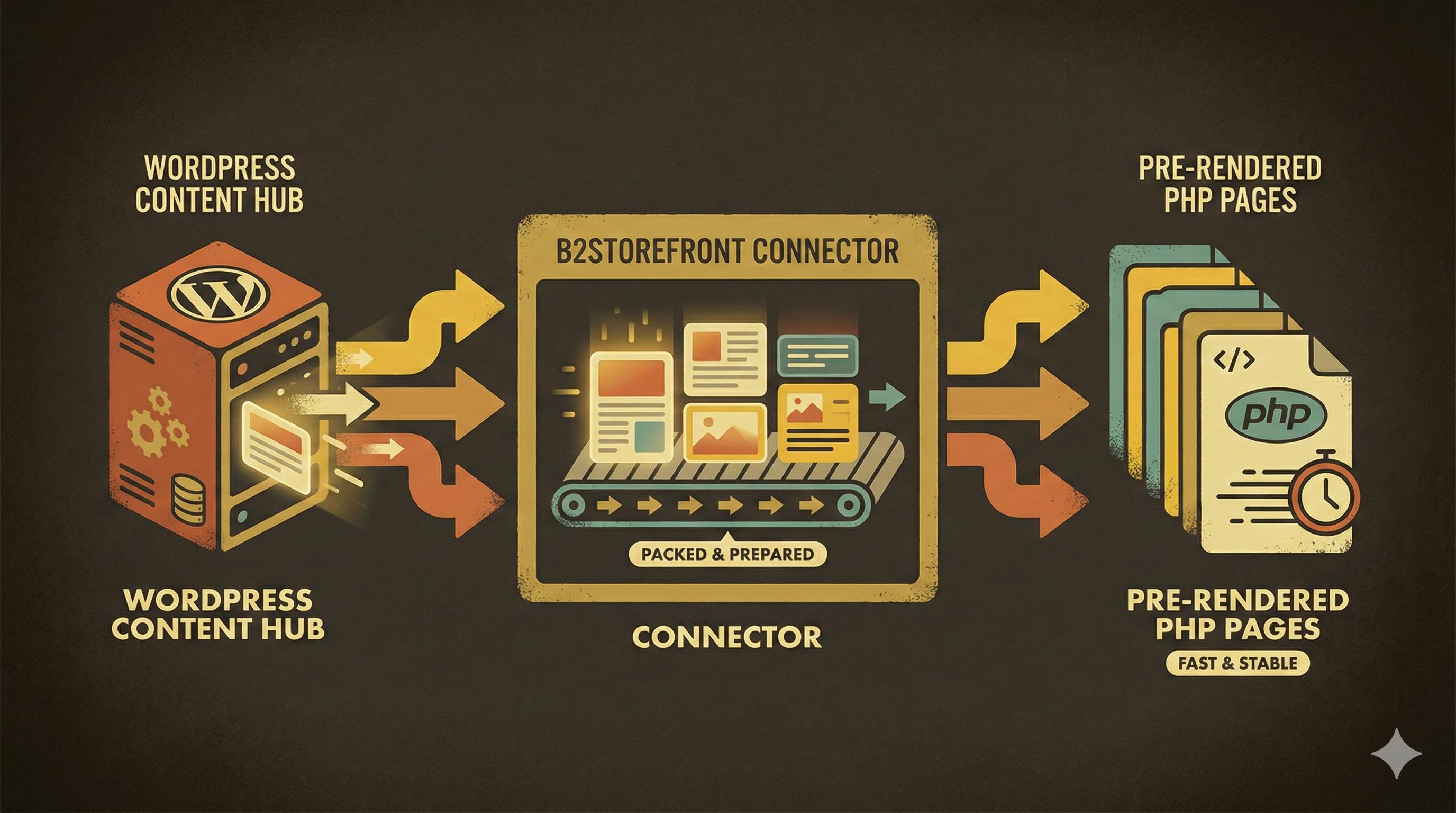
The connector sits next to WordPress and acts as a preparation layer. It reads content from WordPress and packs it into smaller, structured chunks, then pre-generates all pages before any visitor requests them. By the time a user opens an article or a subpage, the page already exists.
The key difference is that these pages are generated as pre-rendered PHP files, not dynamic WordPress pages. They are served directly by the server without loading the WordPress core, without running the theme stack, and without triggering plugins on every request.
At runtime:
- WordPress is not executed
- The WordPress core is fully detached
- A database connection is not required to serve an article
- Pages are built using the pre-packed content library
At the same time, this approach stays within the PHP ecosystem. Because the output is still PHP, it keeps backward compatibility where needed. Selected WordPress features, custom logic, or plugin behavior can be reused during the build process or selectively at runtime, without turning WordPress back into a bottleneck.
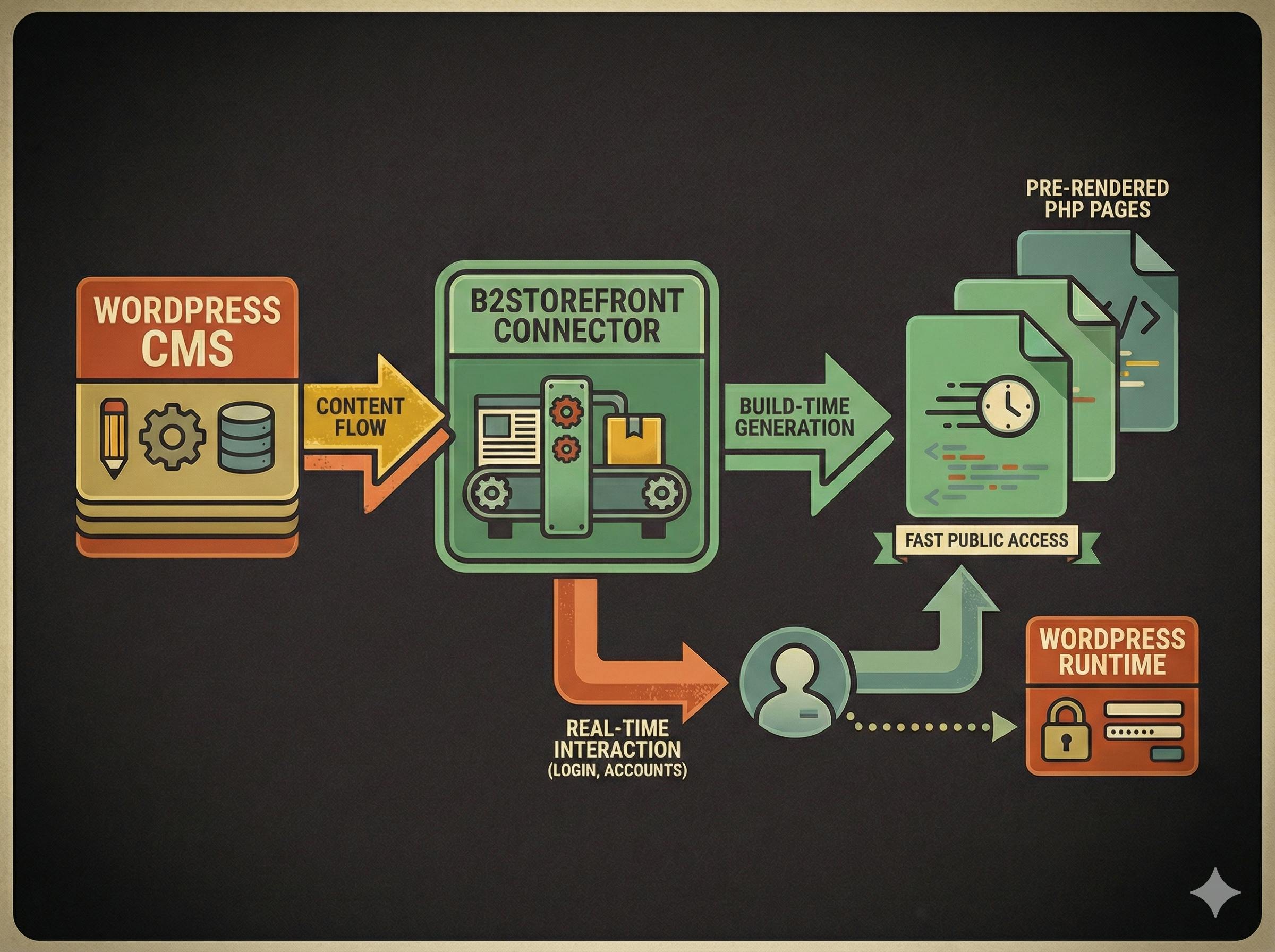
This allows us to keep the practical benefits of WordPress — content structure, editorial workflows, and existing logic — while removing the most expensive part of the system: runtime WordPress execution.
In short, WordPress becomes a content factory, not a traffic handler. The B2Storefront Connector shifts all heavy work to build time, so page delivery stays fast, predictable, and inexpensive, even at scale.
This model also allows WordPress to run selectively, only where it makes sense. Pages that require real-time interaction — such as user login, account management, or protected areas — can still be served by WordPress directly. At the same time, high-traffic pages like article listings, content pages, and SEO entry points remain fully pre-rendered and served without loading WordPress at runtime.
What this unlocks
By moving all heavy work to build time and serving pre-rendered PHP pages, this model removes WordPress from the critical path of page delivery. The result is a platform that behaves like a static site under load, while still keeping the flexibility of PHP where it matters.
Key benefits include:
- Near-static performance
Pages load without booting WordPress, delivering very low TTFB and consistently fast response times. - Stability during traffic peaks
Traffic from search engines, aggregators, and AI crawlers no longer affects availability or publishing workflows. - Lower infrastructure pressure
CPU and database usage drop significantly, reducing the need for constant server scaling. - Stronger security posture
WordPress does not need to be publicly exposed, which reduces the attack surface and limits automated attacks. - Safer updates and maintenance
Core and plugin updates are less risky because they are no longer part of the runtime delivery layer. - Preserved WordPress workflows
Editors continue working in a familiar environment without performance degradation. - No full rewrite required
Existing content, logic, and PHP-based features can be reused instead of rebuilt. - Selective runtime flexibility
WordPress can still handle dynamic or user-specific areas (login, accounts, dashboards), while public and high-traffic pages remain fully pre-rendered and fast.
Together, these benefits create a system that is faster, more predictable, and easier to operate at scale, without forcing teams to abandon WordPress or take on the risk of a complete platform rewrite.
When this model makes sense
This approach is designed for WordPress platforms that have reached a scale where performance and cost become structural problems, not temporary issues.
It works particularly well for websites that:
- publish large volumes of content and grow continuously over time
- manage hundreds of thousands or millions of articles
- experience frequent traffic spikes from search engines, aggregators, or social platforms
- are heavily affected by SEO crawlers and AI bot traffic
- rely on WordPress features, plugins, or PHP-based business logic
- are operated by small or lean development teams
- want to avoid the cost and risk of a full frontend rewrite
- need to mix public, high-traffic content with authenticated or user-managed areas
For these platforms, the goal is not to replace WordPress, but to change its role. WordPress becomes a controlled content and build system, while page delivery is handled by a fast, predictable, and scalable layer.
This model is especially relevant for owners and CTOs who are deciding between endlessly scaling infrastructure or rewriting the entire platform — and are looking for a third option that delivers performance without sacrificing stability or flexibility.